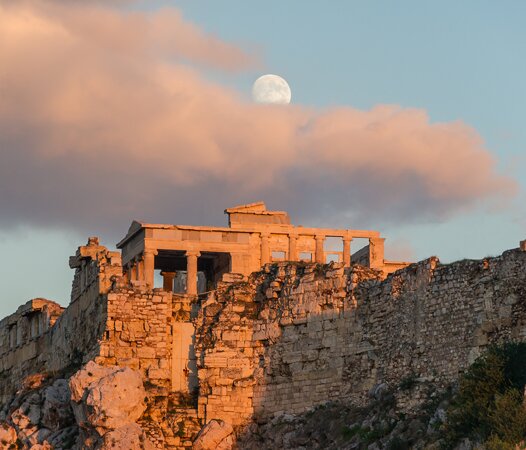
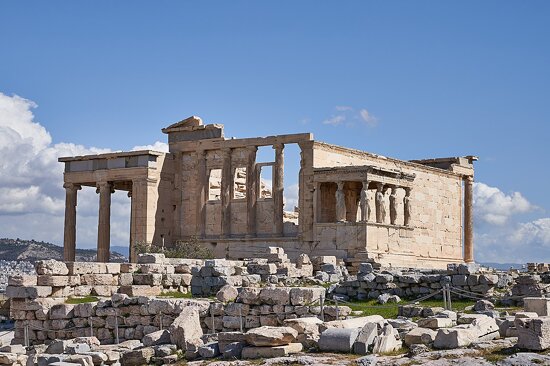
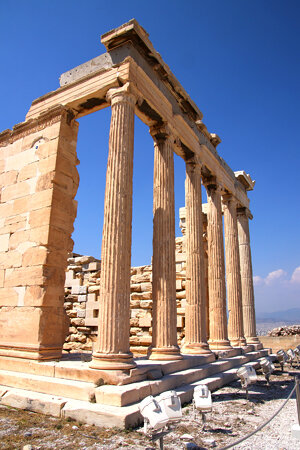
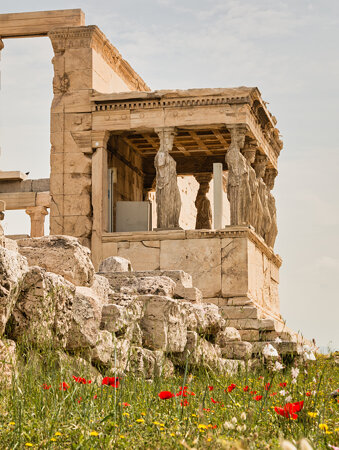
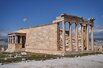
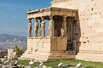
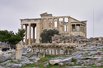
The Erechtheum (Ελληνικά. Έρέχθειον Erechtheion) is an ancient Greek temple on the north side of the Acropolis of Athens in Greece.
The temple as seen today was built between 421 and 407 BC. Its architect may have been Mnesicles, and it derived its name from a shrine dedicated to the legendary Greek hero Erichthonius. Some have suggested that it may have been built in honour of the legendary king Erechtheus, who is said to have been buried nearby. Erechtheus and Erichthonius were often syncretized. It is believed to have been a replacement for the Pesistratid temple of Athena Polias destroyed by the Persians in 480 BCE.
The need to preserve multiple adjacent sacred precincts likely explains the complex design. The main structure consists of up to four compartments, the largest being the east cella, with an Ionic portico on its east end. Other current thinking would have the entire interior at the lower level and the East porch used for access to the great altar of Athena Polias via a balcony and stair and also as a public viewing platform.
The entire temple is on a slope, so the west and north sides are about 3 m (9 ft) lower than the south and east sides. It was built entirely of marble from Mount Pentelikon, with friezes of black limestone from Eleusis which bore sculptures executed in relief in white marble. It had elaborately carved doorways and windows, and its columns were ornately decorated (far more so than is visible today); they were painted, gilded and highlighted with gilt bronze and multi-colored inset glass beads. The building is known for early examples of egg-and-dart, and guilloche ornamental moldings.
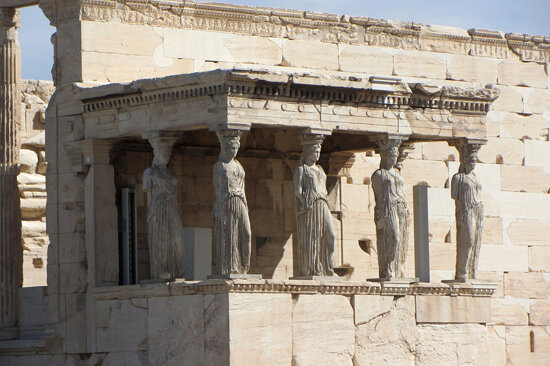
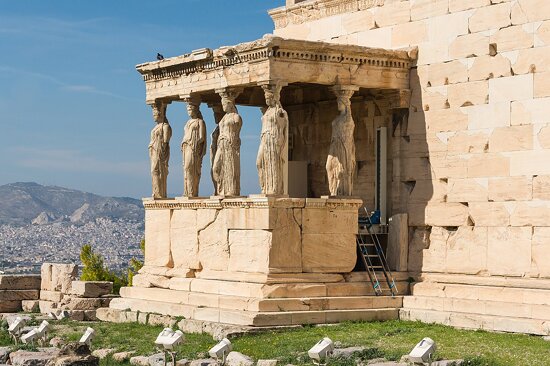
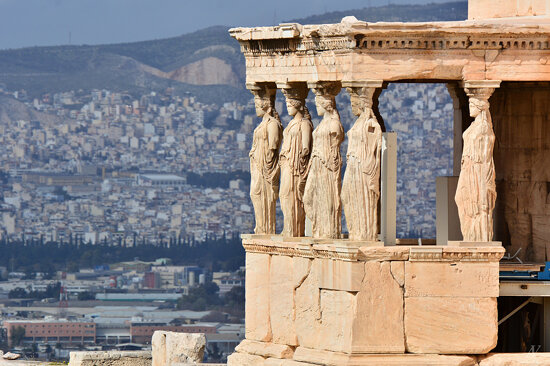
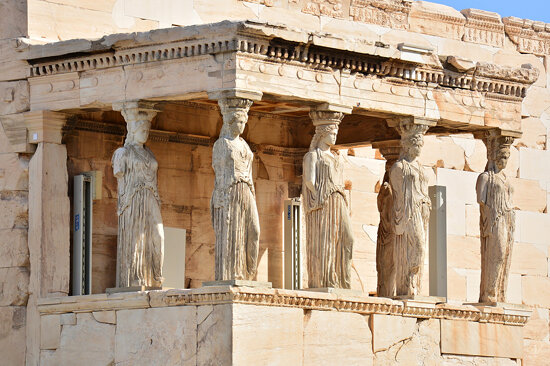
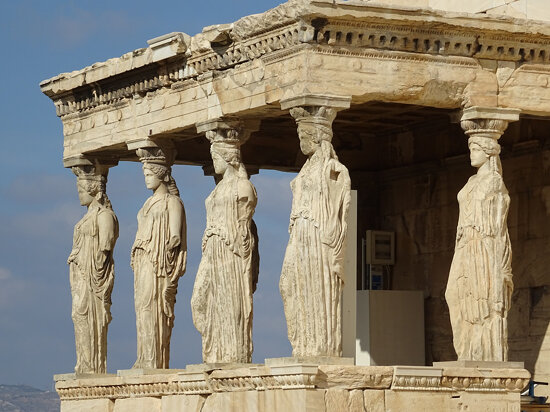
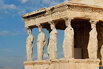
On the north side, there is another large porch with columns, and on the south, the famous "Porch of the Maidens", with six draped female figures (caryatids) as supporting columns, each sculpted in a manner different from the rest and engineered in such a way that their slenderest part, the neck, is capable of supporting the weight of the porch roof whilst remaining graceful and feminine. The porch was built to conceal the giant 15-ft beam needed to support the southwest corner over the metropolis, after the building was drastically reduced in size and budget following the onset of the Peloponnesian war.
The Erectheum was associated with some of the most ancient and holy relics of the Athenians: the Palladion, which was a xoanon (defined as a wooden effigy fallen from heaven - not man-made) of Athena Polias (Protectress of the City); the marks of Poseidon's trident and the salt water well (the "salt sea") that resulted from Poseidon's strike; the sacred olive tree that sprouted when Athena struck the rock with her spear in her successful rivalry with Poseidon for the city; the supposed burial places of the mythical kings Cecrops and Erechtheus; the sacred precincts of Cecrops' three daughters, Herse, Pandrosus and Aglaurus; and those of the tribal heroes Pandion and Boutes.
The temple itself was dedicated to Athena Polias and Poseidon Erechtheus. Within the foundations lived the sacred snake of the temple, which represented the spirit of Cecrops and whose well-being was thought essential for the safety of the city. The snake was fed honey-cakes by Canephorae, the priestesses of Athena Polias, by custom the women of the ancient family of Eteoboutadae, the supposed descendants of the hero Boutes. The snake's occasional refusal to eat the cakes was thought a disastrous omen.
The intact Erechtheum was extensively described by the Roman geographer Pausanias (1.26.5 - 27.3), writing a century after it had been restored in the 1st century AD. The internal layout has since been obscured by the temple's later use as a church and possibly as a Turkish harem.
One of the caryatids was removed by Lord Elgin in order to decorate his Scottish mansion, and was later sold to the British Museum (along with the pedimental and frieze sculpture taken from the Parthenon). Athenian legend had it that at night the remaining five Caryatids could be heard wailing for their lost sister. Elgin attempted to remove a second Caryatid; when technical difficulties arose, he tried to have it sawn to pieces. The statue was smashed and its fragments were left behind. It was later reconstructed haphazardly with cement and iron rods. Nowadays the five original Caryatids are displayed in helium-filled glass cases in the Acropolis Museum and are replaced in situ by exact replicas.
The Caryatids are in the process of being transferred to the New Acropolis Museum. The first was carried over safely on December 9th, 2007, via an elaborate system of aerial cranes. Within the new museum, the statue was reunited with its long-missing sandalled left foot, which was identified among rubble in the 1980s. The reassembled Caryatid, along with the four others remaining in Athens, will have its decayed patina thoroughly restored by laser, and will be displayed in the new museum, encased within noble gas-filled glass chambers.